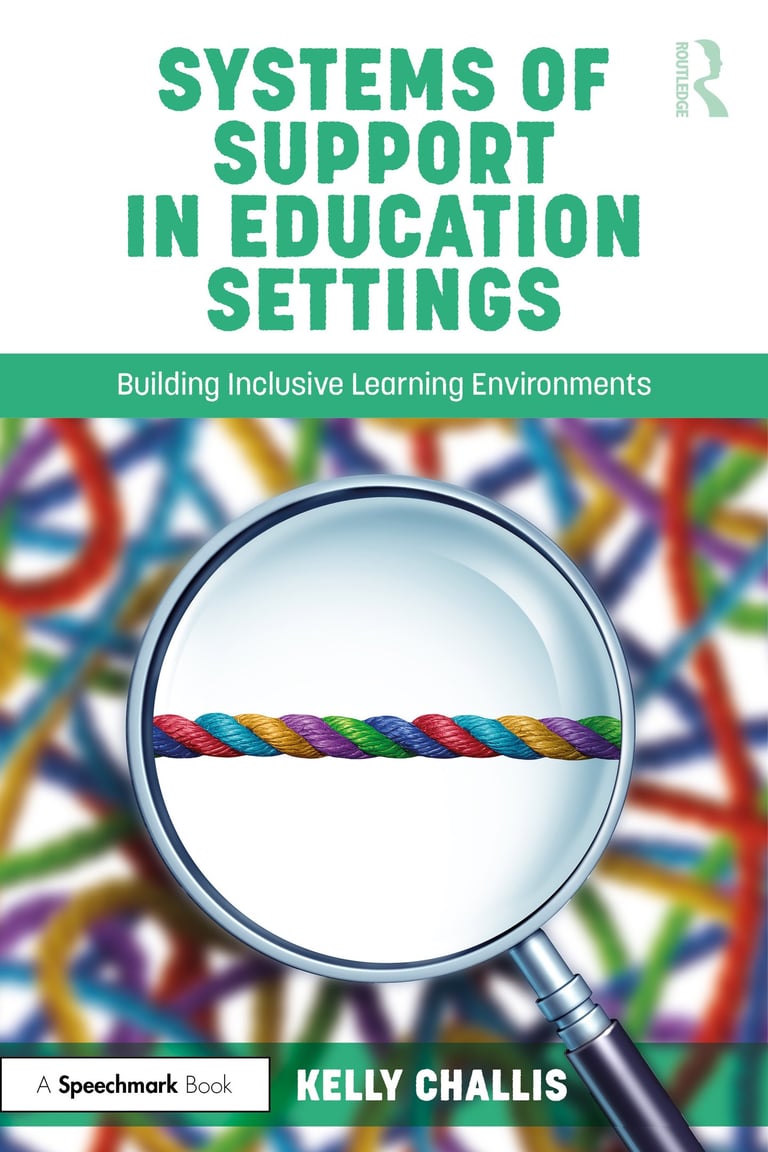
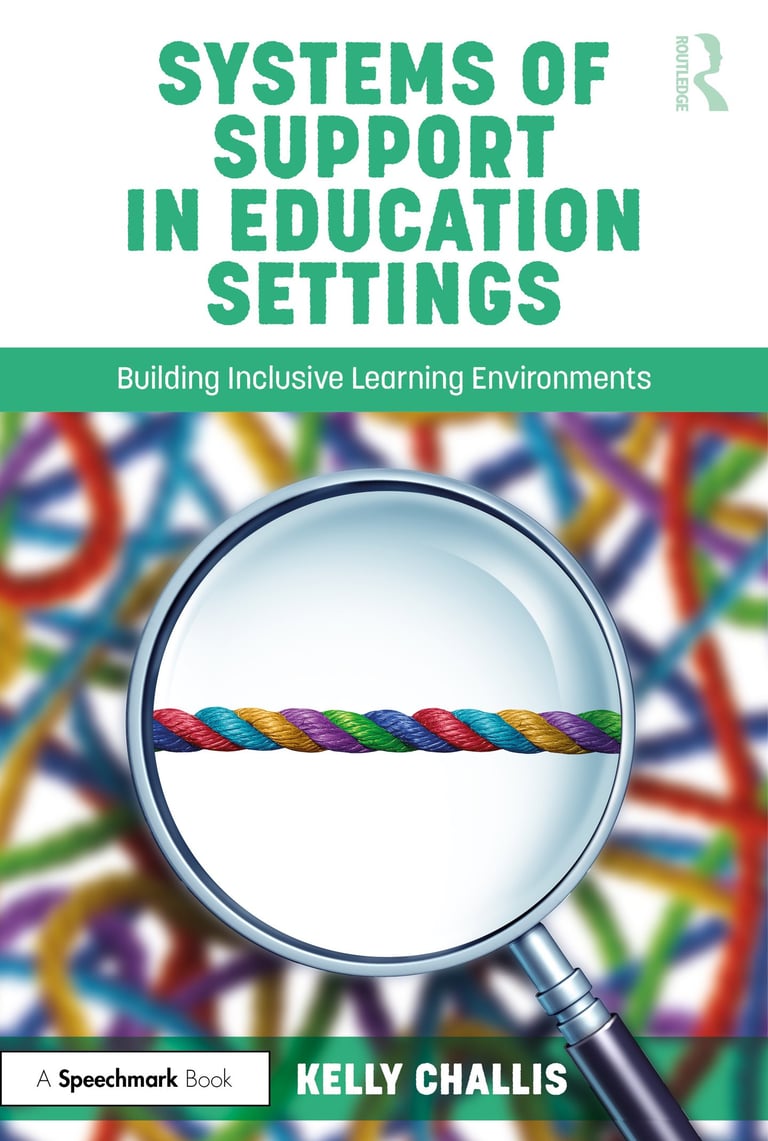
-The Book
Systems of Support in Education Settings
Every classroom has neurodivergent children and young people in it. How you support them has a lasting impact, in fact, not just them. but on everyone in the environment. This book is my attempt to give practitioners the tools to work with the children and young people.
Published by Speechmark-Routledge
Essential reading for teachers, SENCos and leadership teams
Suitable for Primary and Secondary settings
Not a one-size-fits-all
Something better.
-Why I put pen to paper
I spent years working alongside practitioners who were doing their best for neurodivergent learners, at all levels in an education setting. They were missing the framework to make sense of the complexity in front of them. They were surrounded by strategies which lacked structure.
This book introduces systems thinking to an education setting. It asks you to get comfortable with uncertainty, look for patterns and connections and be willing to change when something isn't working. That's not a weakness, it's what great teaching requires.
It's written with you and learners at its heart. Practical, honest and designed to stay useful long after you've finished reading it.
"By increasing your awareness and remaining curious about the individual needs in your classroom, you will enrich the learning experience for all"
-What's inside
Ten Chapters.
One connected system.
The book is structured around a central idea that everything connects. Each chapter builds on the last and all roads lead back to the same question: how do we build systems to support every learner?
Systems of Support
Chapter Map- Systems of Support
Ch. 1
Systems Thinking- introduction and models.
Ch. 2
Education: bias, equality, diversity and disadvantage
Ch. 3
An Exploration of SEND- history, policy and broader perspectives
Ch. 4
Learning differences, transition, strengths and classroom interventions
Ch. 5
Popular cognitive theories and their relation to education
Ch. 6
Governance and whole school approaches to support SEND
Ch. 7
Classroom support strategies
Ch. 8
Specialist support, professional reports and EHCPs
Ch. 9
Mind health and its role in the system
Ch. 10
A final letter- pulling all the threads together
10
10
Specialist and lived experience contributors
Chapters building a complete, connected framework
In-depth case studies showing systems thinking in action
10+
6
Multiple perspectives in every chapter.
The book doesn't just give you my view. Each chapter includes at least one contributor from a subject specialist or lived experience professional, people who know this territory from the inside. Their voices build on the themes and give you something to sit with long after you've turned the page.
-Case studies
Six real scenarios.
Systems thinking applied.
Each case study takes a common situation from an education setting and walks through it step-by-step showing how systems thinking changes what you notice, what you do and what becomes possible.
01
CASE STUDY
CASE STUDY
CASE STUDY
A dyslexic/dyspraxic, ADHD learner struggling with reading
A 17 year old learner with processing difficulties falling behind in science
An NQT planning a new topic with literacy integration
02
03
06
05
04
CASE STUDY
CASE STUDY
CASE STUDY
A learner who finds it difficult to access small group work
A family applying for an Educational Health Care Plan
A 14 year old with anxiety struggling to attend school
-Get your copy
Ready to build a system that works?
Available from Routledge and Amazon. Whether you're an NQT finding your feet or an experienced teacher looking for a new framework this book will give you something to work with.
Also available as an ebook. For bulk orders for schools and trusts please get in touch.